

Last weekend I popped along to an event that was billed as a Public Consultation on the question of ‘Should Glastonbury be a World Heritage Site?’ Unfortunately, I feel the event failed to inform or consult and from numerous posts on social media it seems many in the town feel the same.
I was made aware of the consultation by this Facebook post from former mayor Jon Cousins:
“Glastonbury Town Council has been considering the feasibility of moving forward with such a proposal, but, more importantly, we’d like to know how you – the members of Glastonbury’s community – feel about it. Therefore, the Council will be holding a number of Open Days where you can come and find out more, and let us know what you think: Should Glastonbury be a World Heritage Site?
This question has been raised a number times over the past 20 years, and many residents may recall there was an initial exploration of World Heritage Status for Glastonbury in 2006.
In 2016, the High Sheriff of Somerset, Edward Bayntun-Coward DL, expressed his support for the idea: “The advantages of being granted World Heritage Site status are potentially enormous – comparable to Three Michelin Stars – it creates a universal brand. It would boost self-esteem along with visitor numbers and attract investment (hotels, restaurants, etc.). The sites need to be clearly defined – Glastonbury Tor and Abbey; these are indisputably of outstanding universal value.”
As Chair of the Town Council’s Glastonbury World Heritage Status Committee, I am delighted that our council is prepared to take this positive step on behalf of all the residents of Glastonbury. It is vital that we have strong community support for this initiative over the next few years, so all local people and stakeholders will have an opportunity to comment and be consulted on the emerging proposals concerning World Heritage status.”
The Consultation
I was interested to hear how World Heritage Status might benefit the Town and looked forward to a lively discussion on how people felt about the idea, the pros and cons, likely costs, and implications in terms of visitor numbers, planning, services etc.
When I turned up the Town Hall on the Saturday morning it was sparsely populated. I wouldn’t say the atmosphere was buzzing exactly, it felt a bit like a wake for an elderly uncle that none of the family had much to do with but they thought they better show up in case there was something for them in the will.
I looked around for some information on the anticipated benefits of World Heritage Status to the Town, perhaps something about the experience, both good and bad, from residents of other places that had been through the process, but I couldn’t see anything. There were brochures listing Glastonbury’s attractions, we’ve already paid consultants to produce these and they are now available for us to look at, presumably in case any of us haven’t noticed that we have an Abbey and some other buildings of historic interest.
The consultants also produced ‘A few questions for residents, pilgrims and visitors to help us know what you think’. Take a look. Personally I found it patronising.


I sat with some elder Avalonians (worryingly not much older than myself!) we shared some of our concerns about Glastonbury’s difficulties in handling the current volume of visitors (and their vehicles) at peak times, the ever-widening social divide in the town, the homelessness and scarcity of services, the need for social, communal and affordable housing and the growing numbers of people, largely from the cities, who are in the fortunate position of being able to buy up property in the town, raising both house prices and rents above what many locals can afford.
Nothing about the event reassured me that World Heritage status would provide solutions to this situation. I also have concerns about how moulding the town to fit the understandably strict criteria of World Heritage status would affect its cultural life and future development. There was a forty-minute presentation by the consultants, I had a prior engagement and couldn’t stay for this. I would like to have the opportunity to watch it on video, but this opinion has not been made available. I have since heard that the main focus of the presentation was not on the advantages of World Heritage stats but on bringing ‘better’ visitors to the town, but the consultant was unable to explain what constituted a ‘better’ visitor.
This was going to be a brief Facebook post in which I suggested how the event might have been better presented to elicit a more positive response from the locals, by actually answering our questions and explaining why it was decided to commit 40K over two years to outside consultants without asking the town whether this was a wise use of funds. However, I find it hugely significant that it was nearly 20 years ago that World Heritage status was first considered and I think it is important to consider what has happened over that period.
Glastonbury Since 2006
Glastonbury has changed enormously since World Heritage status was first posited in 2006. I think it is fair to say we had a fairly niche appeal in those days, Glastonbury was a place of pilgrimage for those with interests that were considered rather esoteric and even wacky, such as the Grail legends, Celtic Christianity, Paganism, New Age beliefs and ‘Alternative’ communities. Many people in the UK weren’t even aware that the town existed separate from the nearby festival, which had not yet become an event of mainstream appeal.
These were the days before social media, Glastonbury had very little online presence and official tourist promotion of the Town glossed over, or completely ignored, the ‘Alternative’ aspects, lest coach parties, seen as the town’s ‘bread and butter’ should be put off visiting the historic ruins of the Abbey.
Since then, ideas and interests being explored here, such as veganism, complementary medicine, goddess worship, paganism, bodywork, environmentalism, earth energies etc have become mainstream. More shops opened, catering to niche interests. The calendar of conferences grew, with those of a like mind coming in growing numbers and from further afield each year. Glastonbury’s music scene started to attract a wider audience. Gatherings which had begun as seasonal community celebrations, or small markets, became better organised and professional and attracted visitors from around the world. These were just some of the gradual but profound changes in Glastonbury that have transformed its global profile and popularity.
And yet despite growing visitor numbers, Glastonbury has retained its uniqueness. From my many conversations with visitors what has come across most strongly is that unlike most ‘tourist’ destinations those who come here on pilgrimage (and I mean that in its widest possible sense) feel welcomed and accepted here. Glastonbury feels like home. They come back, again and again, becoming part of the wider community. That wider community, which many call Avalon, has no boundaries of geography, colour, creed or class, but embraces all drawn in by the particular and peculiar energy of this place. Quite how these visitors could be ‘better’ I’m not sure.
All these changes and developments that have drawn people to the town feel very grassroots and organic to me, someone would have an idea for an event or business or a community group and join others in making things happen. Up until relatively recently, many of the events that are now attracting visitors in large numbers happened despite the ambivalence, or the opposition, of the ‘establishment’ and with rarely anything in the way of funding. This may be why many of us, regardless of our politics, feel deep disquiet around these plans. Top-heavy initiatives feel like an imposition on the Town, promises of outside investment often don’t feel like a good fit.
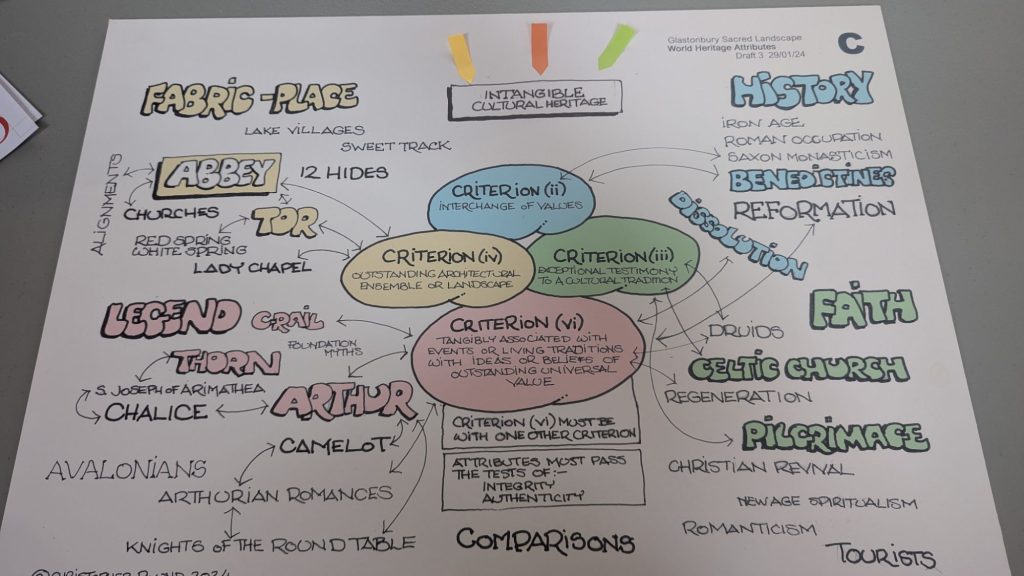
Why, despite our success at attracting visitors, is it now believed by some that we need to employ consultants, who have no prior knowledge of or understanding of the town, at considerable expense, to draw charts that tell us what we already know, so they can present the town’s assets to best fit UNESCO’s criteria, regardless of whether this award is going to usefully serve the Town?
Glastonbury town – The Brand
Let me remind you of the words of the High Sheriff from 2016: “(World Heritage Status) creates a universal brand. It would boost self-esteem along with visitor numbers and attract investment (hotels, restaurants, etc.)” I’ve got no beef with Edward Bayntun-Coward DL, he’s the owner of a venerable bookbindery and a seller of rare books, so he sounds like just my sort of chap, but I find those words almost chilling in the context of Glastonbury in 2024.
I detest the idea of Glastonbury as a ‘brand’. We’re a living, breathing community, set in a landscape. Glastonbury was not designed by town planners, it evolved. It is shaped by time, landscape, religion, politics, war and social movements. We’ve not got a board of directors, human resources and a creative team all ultimately answerable to shareholders. The investment that has made this town what it is in the blood sweat and tears of multiple generations, living, working and weaving the stories of their lives here. You can’t reduce the spirit of this place into a product to be packaged up and sold with some pretty images, a colour palette, a logo and some hashtags.
I don’t think we’re suffering from a deficit of self-esteem right now, I’d say we’ve got plenty of reasons to be proud of our colourful and blooming town. Yes, we’ve got issues, show me a town that hasn’t. We need and indeed want visitors but this needs to be balanced with the needs and desires of the locals and an appreciation for the environmental constraints of the area. As for investment, if this comes in the form of money from outside investors who answer to their shareholders rather than their neighbours, or holiday-home buyers, I can see it destroying the very things that make Glastonbury special. There is uproar on local social media groups, some believe World Heritage Status would lead to restrictions on access to the Tor and entrance fees.
Perhaps World Heritage status can help us to navigate the future, show us how to find space for our visitors’ cars and accommodate them without making everyone in the service economy homeless. They might find funding to protect our crumbling medieval architecture and protect us from corporate greed and untrammelled development. But all we seem to have to show for our money so far is some patronising brochures and a public consultation that feels more like the sales pitch for a timeshare apartment than a serious attempt to engage interested locals.
In 2007 Pricewaterhouse Coopers estimated that it cost almost £500,000 to prepare a nomination for World Heritage status, that’s a serious amount of money to risk on a bid that might come to nothing, if we fail to jump through the hoops and tick the required boxes. As it is, we’ve been doing rather a lot of hoop-jumping and box-ticking for the Town Deal money and I’d quite like to see what benefits those projects bring (when they are eventually completed) before we all put on our trainers and leotards for the next round of ‘Impress the Men in Suits Athletics’.
I believe the town might have been better served by having a public town-wide consultation on the visitor economy. We need creative solutions for crowd management, parking, accommodation, promotion, and improving accessibility for a start. We’re fortunate to welcome visitors all year round, largely they come with a genuine interest in and love for the place, they are not just ticking boxes on an itinerary. We already know what is special about our town, we don’t need an external body to tell us whether we’re good enough.
I’m not trying to put the boot into the local council here, most of them are friends of mine and I believe they are genuinely trying to do their best for the Town. But what looked like a good idea 20 years ago might not be now. If this is going to come across as anything other than a very expensive vanity project they need to properly consult with and inform the townspeople before committing large amounts of money to it.
Further reading:
I found some interesting critiques of the benefits of World Heritage Status in these articles, I highly recommend you take a look:
Thomson Reuters Foundation – Are World Heritage Site listings a blessing or a curse? by Rina Chandran
The Conversation – World Heritage status can be a poisoned chalice for cities by Aylin Orbasli
No one paid me to write this piece, if you found it of interest please take a look at how you can support my work.
Update
The World Heritage Status debate has caused quite a furore in Glastonbury. Generally, the responses to my post on the NFG Facebook page were thoughtful and respectful, but I was concerned by the tone of some posts on local groups and pages, this prompted me to write the following, which I published on the 28th of October. If you have Facebook and want to see the responses you can find it here:
“Following on from my recent post about World Heritage status, someone commented that Glastonbury’s councillors are uninclined to communicate with the townspeople, which got me thinking. Even before I published that piece some posts had started circulating suggesting that the World Heritage status bid was going to result in UNESCO ‘owning’ the Town. Some claimed that councillors were lining their own pockets, or simply didn’t care about the Town and its people. Now I’ve never been a Town councillor, I really don’t like meetings and I spend so much time sitting on the fence that I would probably abstain on every vote. However, I have noticed one thing unites everyone on our local council, regardless of their political affiliation, they are all human.
Humans tend to communicate much better when they are being listened to and not being shouted at. I’ve worked with musicians and noticed that the quality of a performance is nearly as dependent on the receptiveness of the audience as it is on the band, it’s a two-way process. I’m much more inclined to go and sit with a friend who is always positive and encouraging than someone I’ve mostly encountered on social media who has called me an arsehole.
It seems to me that we have become so anti-authoritarian in this town that we ascribe the most dreadful motives to anyone who puts their head above the parapet, even those we pass every day on the street. Yet we then expect them to feel safe and comfortable enough to sit down with us in real life and listen to our concerns.
I’m aware that it’s a two-way process of course, not everyone on the council is a good communicator, I’ve seen some of them make some outrageously provocative comments online themselves. Local politics is also tribal, people often dismiss others’ ideas without considering their merit if they belong to ‘the other side’, while supporting those from their party no matter how wrongheaded. Personally, I don’t think political parties have a place in parish councils. Politics discourages people from working together to find the best solutions for local problems. Most people, and certainly those who volunteer their time on local committees, want the best for others in their community, if they were purely interested in lining their own pockets they’d go into finance, private dentistry or estate agency.
Did you know that our parish councillors do not get paid? Even our mayor only gets a meagre allowance for the catering for mayoral events. Two of our councillors who represent the Town at Somerset County Council, get a £15.5k a year allowance. Even the council leader of Somerset Council only earns £38,750 – about the same as an experienced plumber might expect. From what I understand the bad old days when you could grease a councillor’s hand to get a lucrative contract or approval for your house extension are long gone.
Point out when you think the council have got it wrong, if you have actual concrete evidence of it call it out, but please don’t throw stones and hurl insults. The vast majority of councillors and others active in the community are sitting through endless, boring meetings because they genuinely want to do something positive. Even if one of them has decided that people like you are the problem then you aren’t going to change their minds by slinging mud at them.
I genuinely believe that it’s possible for people to work together for the best possible outcome for all of us, we all want homes, services, clean and pleasant streets, a healthy environment, and worthwhile and satisfying work and play. Most of us accept that visitors bring all sorts of benefits to the town. Most of us are prepared to make some compromises towards the greater good, provided we can be confident that others are doing the same.
Why are we so inclined to take a side rather than look for common ground?
I was very careful when I wrote the piece on the World Heritage status not to find every possible worst-case scenario and suggest it as the inevitable outcome, or to decide that everyone else was wrong and point fingers or appoint blame. I honestly don’t know if World Heritage status would be a curse or a blessing, what motivated me to write the piece was that the consultation didn’t bring me any closer to an understanding. This is too important an issue not to involve the community properly and intelligently. We don’t need unfounded accusations and anger, or the propagation of worst-case theories as inevitable, these will only entrench people even further into their positions.
We need more communication and more listening”.
Header Image by Gaya Xtall from Pixabay
Enjoy this post?
Then you’ll love my books – ‘Normal For Glastonbury: Life in England’s Most Magical Town’ and my ‘Crap Views of the Tor’ Postcard Book. I’ve produced canvas Tote bags featuring my funny Normal For Glastonbury Town Map. There’s Mugs and more in my Online Shop too.
Join the Community: My readers support this blog to keep it independent and ad-free, so I cancontinue to write about and photograph Glastonbury Town and its wonderful creative community. For more of ‘this sort of thing’ join the We Are Normal For Glastonbury membership site, for exclusive content, a comprehensive guide to making the most of your visit to the town, a personalised membership certificate and more. Membership is only £20 a year.
You can also subscribe to Normal For Glastonbury by email, follow the Normal for Glastonbury
Would you like to commission and sponsor me to write an article about what you do, for a feature on Normal For Glastonbury? You’d be reaching thousands of readers who love the Town. Please click here for more information.

Brilliant, Vicky! A really enjoyable and wise read. I have great misgivings about our unique and beloved town becoming a World Heritage Site. For me ( like you) my dread of such an outcome was summed up by the chilling word ‘brand’! What an appalling word to use for a vibrant community such as ours. It sums up why I am opposed to such a campaign. As you quite rightly mentioned in your piece, Glastonbury has developed and evolved organically and naturally over time, and is much better for it.
Good to hear from you, Ark, and trust you’re keeping steady (I’ve little doubt you are); and Vicki, this is an excellent piece – one of your best.
Yes: flying a “Heritage” flag is all very well, but what might it actually mean for both residents and our (much-needed and, mostly, welcome) guests here?
One notion I rather liked was the acquisition/hiring of a field (such as the celebrated Herbie’s) to park visitor’s cars and provide two or three very regular small park’n’ride shuttle-buses which, for a small fee, could transport visitors who park there on a circular route to the Beckery and Bridie’s Well, the Chalice Well, the Tor, and back.
And many have also long advocated the pedestrianisation of the High Street between the top of Benedict Street and Archer’s Way, creating a bigger and safer Market Place and a much more convivial High Street; though of course, it’s easy for armchair planners like myself to breezily support such ideas.
XX
I do like the idea of your shuttle bus tour, although of course it will also have to give time to visitors to explore the Town in a less structured manner too. As for pedestrianisation, I think this can only happen following a reduction of vehicular traffic through the town, or it will simply move the problem to the residential roads. I hope we will see a huge uptake of ‘active travel’ enabling less reliance on the car, there are exciting developments taking place with electric vehicles of all kinds (if only the hippies would stop getting brainwashed by the Oil industry into protesting against Green initiatives). We need to revive the campaign to have the inappropriate freight route designation removed from the A361 through Glastonbury. We need to look at how we can welcome visitors without turning the town into a giant car park. Etc, etc……
Thank you Vicky for such a thoughtful piece.
As one of the people who suggested that we go for World Heritage Site status let me share with you my thoughts.
Firstly, I am sad that the consultants made such a bad impression on you. The purpose of this Open Day was to find out whether residents think the the sacred landscape of Glastonbury is of Unique Universal Value. They obviously totally failed!
Personally I love this land and want to protect it from another bypass, from the increasing amount of heavy vehicles roaring down Coursing Batch and Chilkwell St., and from so-called development which has started to creep across the Old Wells Rd. and around Wick. With increasing flooding on the moors, the pressure to build houses and industrial units around the Tor is increasing.
For me this is the primary reason for looking at WHS status, apart from the fact that I think this sacred land is of outstanding universal value anyway and the sticker is only telling others what I and many others already feel. In fact when I mention that we are going for this, many people are surprised that we don’t already have this status.
I agree with you that we have many problems associated with the increasing tourism. That is happening anyway and is something that we somehow need to deal with and I’m not sure what to do. Airbnb has destroyed the rental housing for locals; too many cars – and the Town Council proposal for a Park and Ride was turned down by the Town Deal Fund. Perhaps WHS status will help. Perhaps it will exacerbate the problems. However this increasing number of tourists is keeping the town economy flourishing despite the pandemic which hit other towns far more severely.
I see the origins of the town as a result of the sacred land which led to the abbey, pilgrimage and now tourists.
Please let’s keep discussing this. With best wishes, Serena
Very interesting response there; thank you, Serena.
Dear Serena, Thanks so much for your thoughtful response. I am in total agreement about the need to protect the landscape, if the points you made were the ones being generally emphasised by those in favour of the WHS bid then I would have been somewhat reassured. However, what I’m mainly getting from it is that the bid is about attracting more, and ‘better’, visitors. From my reading around the subject there seems to be little evidence that WHS will be effective in protecting the town from development. it appears that in Liverpool unsuitable development simply led to the withdrawal of WHS and if you consider Stonehenge there is no reassurance to be found there either. It feels like the council have entrusted the future of the town to two consultants who have a very specific remit and will be paid handsomely regardless of the outcome. It seems to me that it would be far more productive to have some round table discussions about the future of the town, like the ‘Bringing Glastonbury Together’ meetings that happened at the end of the nineties and did much to improve communication, encourage discussion and welcome new ideas. There is a huge pool of creativity and talent in this town, I feel sure we could come up with solutions to many of the issues we face.
Let’s leave Glastonbury as it is please! It doesn’t need to be added to a “brand” in my opinion. Thanks you for raising awareness of this potential issue.
Glastonbury isn’t broke and it certainly doesn’t need fixing. Don’t let it be hijacked!
An excellent and balanced article ! Thank You Vicki.
Certainly Tourism is becoming an issue world wide. Whether WHS mitigates or exacerbates the problem is, I think, difficult to see as yet.
While the protection and preservation of these sites is an admirable idea, the administration and implementation of it involve significant funding which can attract less altruistic and more commercially minded people who are more interested in enhancing their reputations and wallets than anything else. “Branding” is a good example of this.
I have long been a Glastonbury “wannabe” but life and family commitments have kept me from realising my dream. However, I have realised that it is the “idea of Glastonbury” which is as important to me as visiting the town which i can only do very infrequently.
Best Wishes
John
I agree with others, you’ve written a thought provoking article Vicky. As a councillor with more than half a century of facsination with and love for Glastonbury from my first visit in 1970 I want what is best for the town. Some forums have hosted unsubstantiated accusations against the council as corrupt and indifferent to the feelings of the town’s residents. This is fantasy. We live in an age that enables total nonsense to circulate rapidly and grow into widespread conviction in the minds of many. Town councillors are not paid a penny of income and most if not all never claim expenses for anything. We don’t all sing from the same song sheet all the time, even among the majority Green councillors, we hold and express different shades of opinion. The councill has invited residents to step forward and join a 16 person committee to review the pros and cons of WHS and as was made clear to the public attending the last council meeting, if the population of a potential WHS site are not behind an application UNESCO will not entertain any application. The council could not be more emphatic in extending the democratic power to the pople of Glastonbury and I’m glad to hear quite a few have stepped forward to be a part of it.